

Table of Contents
- Proactive Healthcare and Annual MRI: A Guide to Informed Screening
- Benefits of Including an Annual MRI in Your Proactive Health Routine
- Can Annual MRI Detect Disease Before Symptoms Appear?
- Understanding the Risks of Elective Annual MRI Scans
- Proactive Screening vs. Diagnostic MRI: What Are the Differences?
- Should You Get an Annual MRI Based on Family History?
- Partnering with Arizona Advanced Imaging for Proactive Health
Proactive Healthcare and Annual MRI: A Guide to Informed Screening
Proactive healthcare and annual MRI involve integrating preventive imaging into a yearly health routine to uncover silent abnormalities before symptoms arise. This approach shifts the paradigm from reactive treatment to early detection, giving individuals greater control over their long-term health.
Proactive healthcare empowers individuals to take charge of their well-being through screenings, lifestyle choices, and informed decisions rather than waiting for illness to appear. Annual MRI serves as a sophisticated screening tool for asymptomatic people, capable of revealing subtle tissue and organ changes that may signal early disease.
Here is all you need to know about Annual MRI, presenting balanced, educational information about what the test entails, its potential advantages, and the key considerations when deciding whether to include it in a personal medical care plan. Having a solid understanding of proactive imaging will let us better appreciate the specific benefits that Annual MRI brings to a forward-looking health strategy.
Key Takeaways
- Beyond general wellness, one of the most common questions we hear is whether an annual MRI can detect disease before symptoms appear.
- While proactive healthcare and annual MRI scans can offer peace of mind, it is equally important to understand their potential risks.
- A proactive screening MRI is an imaging examination performed on individuals who have no current symptoms but carry personal risk factors that elevate their chance of developing certain diseases.
- Individuals with a documented family history of certain medical conditions—such as hereditary breast and ovarian cancer syndromes or a first-degree relative with a brain aneurysm—often explore annual MRI as a proactive surveillance measure.
- If you are considering an annual MRI based on your family history, your commitment to proactive healthcare and annual MRI is clear.
Benefits of Including an Annual MRI in Your Proactive Health Routine
Annual MRI screenings allow you to develop a personal baseline for imaging results and enable radiologists to notice any differences throughout the years, making subtle differences between this year’s MRI and last year’s images more apparent, which would be missed without comparative images. If the patient sees the radiological picture as a series of single snapshots, he should think of MRI screenings like a movie. Viewing all the images together reveals what has happened during each frame, allowing physicians to make better-informed assessments about their patients.
Beyond baseline tracking, annual MRI tests may be performed to help spot early signs of serious health problems, including breast cancer, brain aneurysms, spinal abnormalities, or joint degeneration before symptoms arise. Some diseases begin slowly and show no outward sign of illness until damage is done. The higher-resolution picture generated by an MRI may catch small abnormalities that could then lead to treatment even if no obvious symptoms have appeared yet. In people with a family history of specific kinds of cancer or nervous system conditions, regular scans might prove particularly useful, though you should discuss any decision to add them to your schedule of tests with a doctor first, based on individual risk factors.
If you’re tracking an existing condition—whether a stable lesion, a chronic disease marker, or a post-treatment region—an annual MRI provides a reliable way to monitor progression or treatment response. By taking comparison photographs from year to year, your doctors should be able to make more informed decisions regarding treatment options and potentially catch future problems before they become apparent through symptoms. That’s added assurance and control when it comes to staying healthy.
An MRI doesn’t replace regular checkups at the doctor’s office, physical examinations or other suggested screenings. An MRI can serve as another test that helps add to your overall health awareness efforts. As your trusted radiology partner, we feel that adding an MRI to your health routine adds a new dimension that other screening procedures like mammograms, blood work or a physical exam can’t achieve, helping you get the full picture of your health.
Perhaps the most compelling benefit is the ability to detect disease before you feel unwell, an advantage that can lead to earlier, more effective interventions and greater peace of mind.
Can Annual MRI Detect Disease Before Symptoms Appear?
Beyond general wellness, one of the most common questions we hear is whether an annual MRI can detect disease before symptoms appear. At Arizona Advanced Imaging, your health and clarity are our priority, and we believe in providing balanced, evidence-informed answers about what MRI can and cannot do.
Magnetic resonance imaging (MRI) can show pictures of soft tissue structures in the body, including organs, muscles, tendons, and nerves. As a result, some structural problems might be detected through MRI even though there has been no visible sign of trouble yet. In fact, a patient may not have experienced pain, neurological symptoms, or other symptoms when they were found to have an unruptured aneurysm, a small renal mass, or early degeneration of the spinal discs. On the other hand, many conditions, such as tiny tumors or very minor metabolic disorders, may not become evident on MRI until more serious stages of the condition have developed.
The value of annual MRI for screening depends on the part of the body being looked at, what type of scan is done, and who is doing the reading. For example, a focused examination of your brain could show something abnormal that wouldn’t be seen if you were only given a regular scan; an abdominal MRI could fail to detect small kidney tumours in some circumstances. Moreover, MRI scans don’t tell you about how organs work, a healthy looking heart can still have narrowed coronary arteries. An annual MRI should not take the place of other established ways of screening such as mammograms or colonoscopies.
For those committed to proactive healthcare and annual MRI, the appeal of catching trouble early is understandable. However, this approach can uncover incidental findings such as benign cysts, developmental variants, or minor disc bulges. Learning about an unexpected finding can provoke significant anxiety and often leads to additional imaging or invasive procedures, turning a well-intentioned scan into a source of distress.
If an electronic MRI discovers any problems, this needs to be evaluated alongside any physical evaluations done first. Findings may show no health threat at all if there isn’t any current medical issue. If you get a scan each year to see how things are going, your doctor should review that with you before deciding what steps need taking next based upon your medical and personal history.
Yet, getting MRIs every year can have some serious downsides and potential issues that need to be taken into consideration prior to undergoing routine MRI screenings.
Understanding the Risks of Elective Annual MRI Scans
While proactive healthcare and annual MRI scans can offer peace of mind, it is equally important to understand their potential risks. This overview is for educational purposes only and does not constitute medical advice; every individual should discuss their unique health circumstances with a qualified physician before pursuing elective annual imaging.
A significant consideration in elective annual scanning is the possibility of a false positive—a result that suggests an abnormality where none actually exists. When a radiologist identifies a finding that appears suspicious, it can trigger a cascade of anxiety and additional diagnostic procedures. For a person without symptoms, this stress can be considerable, and the subsequent tests—which may include biopsies or contrast-enhanced imaging—carry their own costs, time commitments, and rare but real procedural risks. Even when follow-up ultimately confirms the initial finding was harmless, the emotional toll of the uncertainty during that period should not be underestimated.
incidental findings are also sometimes discovered, which refers to some abnormality found on the scan that’s unconnected to why the scan was done originally. When people have elective annual scans, incidentalomas occur commonly, many turn out to be harmless. They’re tiny cysts or nodules that haven’t changed significantly since the last time you had your scan. And there might be other kinds of anatomical differences within someone’s body that don’t have anything to do with what happened that year, but could end up needing regular follow-up and repeated imaging in months or years later. This means potentially unnecessary continued medical surveillance if the condition never caused any symptom, never affected that person’s health, costing them both money and a lifetime of worry.
Our view on whether you might want to opt-in to regular MRI scans depends upon this discussion between yourself and your healthcare provider. This involves weighing up what you’ve found out about your own and your family’s medical history. Some people with certain genetic conditions have a high enough risk that they would stand to benefit from this kind of regular checkup. But other people will need to balance the possibility of false positives against the possible benefits. So talk things over with your doctor to find out if there would be any value in having annual MRIs.
Proactive Screening vs. Diagnostic MRI: What Are the Differences?
A proactive screening MRI is an imaging examination performed on individuals who have no current symptoms but carry personal risk factors that elevate their chance of developing certain diseases. The goal is early detection—identifying potential abnormalities before they cause noticeable changes or discomfort. Physicians may recommend this type of scan for someone with a strong family history of cancer, a known genetic mutation, or other predisposing conditions. The exam is scheduled preventively, often on a recurring basis, and serves as a forward-looking health assessment rather than a response to an existing problem.
A Diagnostic MRI is focused on a specific part of the body, called “targeted,” because a patient has symptoms such as headaches, joint pain, or unusual lab results suggesting possible problems. If such symptoms occur, a diagnostic MRI can help determine what might be causing them. Unlike screening MRIs performed without specific problems being present, a Diagnostic MRI is for problem solving. For this type of MRI test, a physician will order a specific area of the body and pose a question about why it’s symptomatic, which prompts the radiologist to create a plan for testing that area specifically.
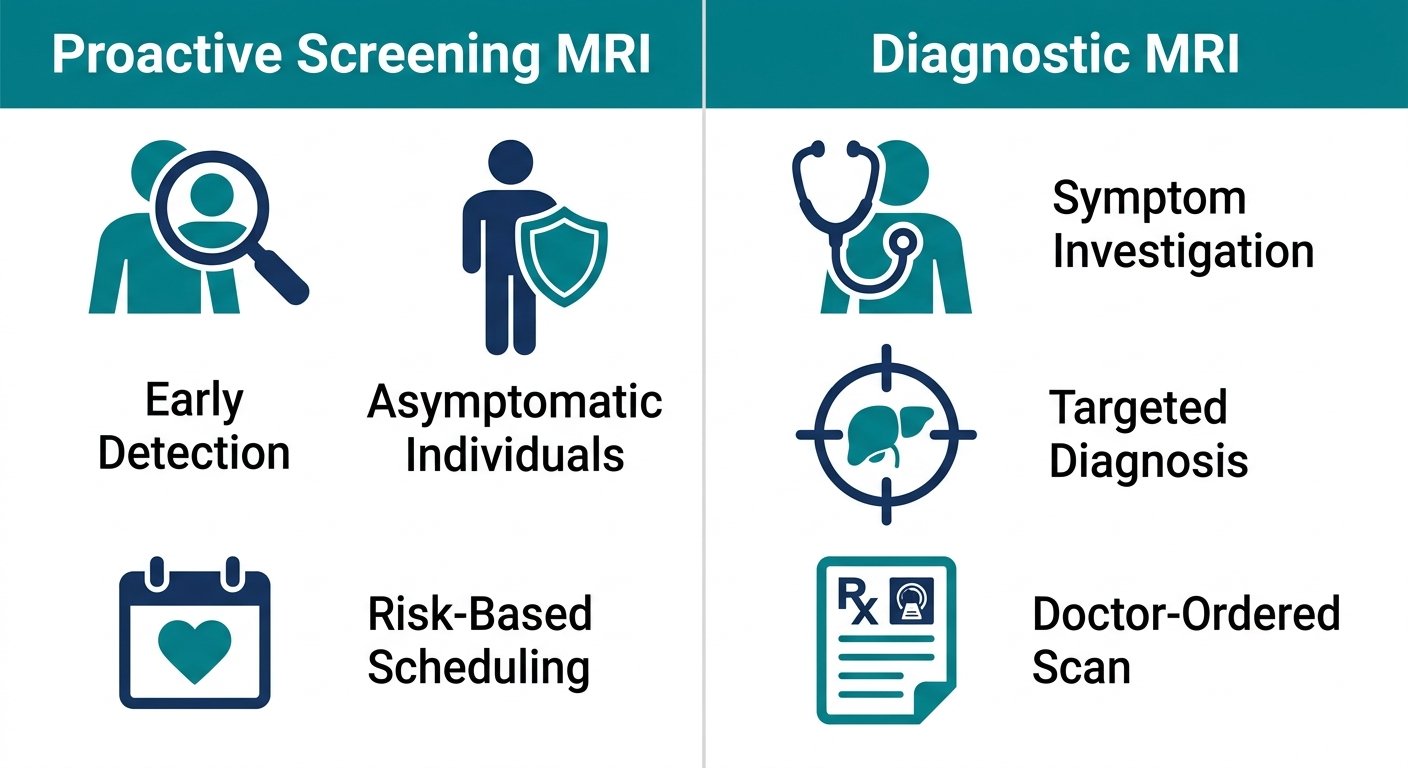
There’s no distinction in equipment for each kind of MRI. Both kinds use magnetic resonance, but what varies is the context and purpose. Screening tests are performed when there isn’t any apparent problem and we don’t know if anything might be going wrong. Diagnostic tests are performed if someone already has a symptom or some abnormality was previously found. In order to distinguish both exams as different, you have to understand that they fulfill different tasks and can’t replace one another. After having determined which role plays each test, the next thing to think about would be if family history should allow us to perform yearly MRI screenings, as that decision also needs thought.
Should You Get an Annual MRI Based on Family History?
Individuals with a documented family history of certain medical conditions—such as hereditary breast and ovarian cancer syndromes or a first-degree relative with a brain aneurysm—often explore annual MRI as a proactive surveillance measure. The instinct to stay ahead of potential health threats is understandable, yet the pathway from family history to a routine imaging schedule requires more than personal concern alone.
Family history may increase the lifetime risk of developing certain conditions but a higher-than-average risk does not necessarily mean that you should have MRI scans every year. Whether you should have MRI scans at all will depend on which hereditary condition you have in your family, your formal risk score based on your genetic tests and any other age-based risk factors such as family history, and how often your doctor recommends having them depending on your case. In some cases you might need to have a dedicated breast MRI every year if you carry a BRCA mutation. But in others if there is only a distant link in your family history then regular scans may not be needed. There are too many variables involved in the decision so always discuss your full family history and your own risks with either your GP or a specialist so they can give advice about whether it would benefit you to have MRIs routinely.
MRI scans are done on occasion to monitor some patients with hereditary cancer syndromes or certain vascular abnormalities, although each case is treated differently. There isn’t necessarily one correct approach for any person, and professional guidance helps ensure that imaging frequency matches actual need rather than generalized anxiety.
Getting regular MRIs as recommended can be part of a comprehensive and preventative health plan. We support patients who undergo annual MRIs when clinically indicated here at Arizona Advanced Imaging. We provide them with quick appointments, prompt reports back from the radiologist, and they will come away feeling comfortable having been scanned in either open or closed MRI systems. Our highly trained staff consists of Board Certified Radiologists and Licensed Technologists who have decades of experience working in Arizona. They work hard to make sure their patients know everything about what’s going on during the procedure.
Frequently Asked Questions
What are the benefits of including an annual MRI in a proactive healthcare routine?
Annual MRI allows you to develop a personal baseline for imaging results, making year-to-year comparisons possible and revealing subtle changes. It may detect early signs of breast cancer, brain aneurysms, or joint degeneration before symptoms appear, and adds a new dimension to other screening methods like mammograms or blood work.
Can a preventative whole-body MRI detect diseases before symptoms appear?
An annual MRI can detect certain structural abnormalities before symptoms arise, such as unruptured aneurysms or early spinal disc degeneration. However, many conditions like tiny tumors may not appear until advanced stages, and MRI does not assess organ function. It should not replace other proven screenings.
What are the potential risks of undergoing elective annual MRI scans?
Potential risks include false positives that cause anxiety and lead to unnecessary follow-up tests, and incidental findings that may require prolonged surveillance or invasive procedures for harmless conditions. Even benign discoveries can trigger significant emotional distress and financial costs.
How does a proactive MRI screening differ from a diagnostic MRI ordered by a physician?
A proactive screening MRI is performed on asymptomatic individuals with risk factors to detect potential disease early, while a diagnostic MRI targets a specific body part because of symptoms or abnormal findings to investigate a problem. Screening is preventive; diagnostic is problem-oriented. Both use the same equipment.
Should I consider an annual MRI if I have a family history of specific medical conditions?
You should consider annual MRI only after consulting a healthcare provider who can assess your formal risk score, genetic tests, and family history. A BRCA mutation carrier may benefit from an annual breast MRI, but a distant relative’s condition rarely warrants routine screening. Professional guidance is essential.
Partnering with Arizona Advanced Imaging for Proactive Health
If you are considering an annual MRI based on your family history, your commitment to proactive healthcare and annual MRI is clear. The next step is partnering with a trusted imaging center. At our imaging center, we have been serving patients since 2001, and our scans are interpreted by board-certified, fellowship-trained radiologists in musculoskeletal and neuro imaging. For personal injury cases, we accept liens and letters of protection, ensuring no upfront costs while you focus on recovery. We serve patients across Arizona and Texas through a network of outpatient centers that prioritize comfort and diagnostic clarity. Results may vary based on individual patient conditions, and we encourage you to consult with a healthcare professional for diagnosis and treatment advice. Our Privacy Policy is available on our website. We invite you to schedule your annual MRI today and take a confident step toward proactive health, knowing you have a dedicated partner in medical imaging.
Start Your Proactive Screening Today
You’ve learned how annual MRI can establish a personal baseline, aid in early detection, and help monitor your health over time. Now, take the next step with our imaging center, a trusted provider serving patients since 2001. Our board-certified, fellowship-trained radiologists interpret every scan, ensuring clarity in every image and confidence in every decision. With report turnaround times as fast as 24 to 48 hours, you won’t have to wait long for answers. Whether you’re considering screening based on family history or simply want greater peace of mind, we’re here to support your proactive healthcare journey. We offer MRI services designed to help you stay ahead of potential health issues.
Start Your Proactive Screening Today