

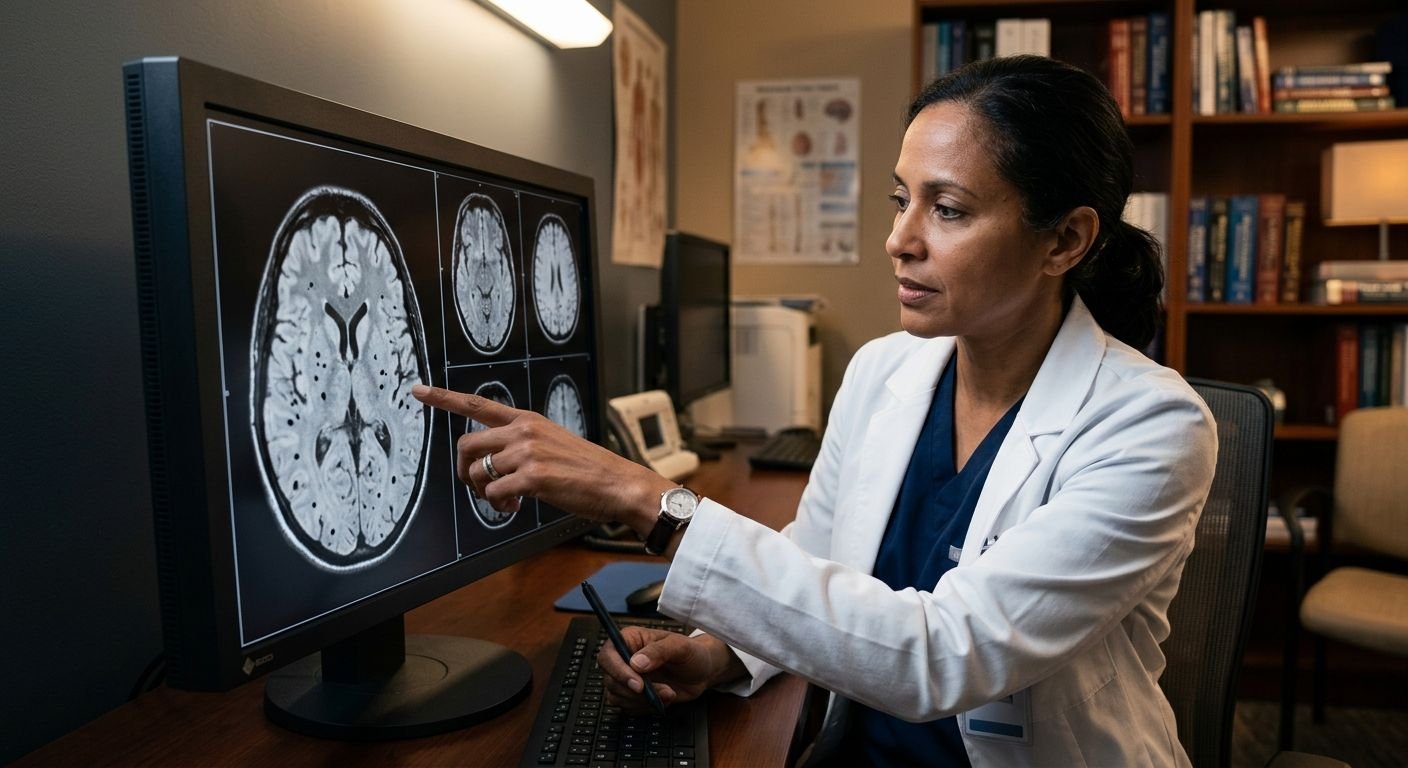
Susceptibility-weighted imaging (SWI) is an MRI technique that can contribute information about susceptibility differences, including some blood products. Its findings require interpretation within the clinical assessment.
Avoid universal detection claims
SWI can be useful in evaluating microhemorrhages in appropriate circumstances, but it cannot guarantee that every clinically significant microbleed or traumatic injury will be detected.
No fixed 50% detection or sensitivity advantage is asserted here. A numerical comparison requires the exact study population, scanner, acquisition technique and comparison method.
What imaging can and cannot establish
A concussion assessment starts with a healthcare provider’s clinical evaluation. Brain imaging is not routinely needed to identify every mild TBI or concussion; the clinician selects tests when they address a specific concern.
CT and MRI can help evaluate some structural injuries, but they cannot detect every TBI. A normal scan does not by itself exclude a concussion, and an abnormality must be interpreted in clinical context.
Advanced methods such as DTI, SWI and quantitative analysis have different uses and limitations. Do not treat a technique, software result or marketing protocol as a stand-alone diagnosis or a guarantee that subtle injury will be found.
Discuss the ordered protocol
Ask the ordering clinician why SWI or another advanced sequence is being requested and what limitations should be expected. Confirm that the specific protocol is available at the selected center.
A report should describe findings and uncertainty rather than turn imaging into automatic proof of symptoms, accident causation or a legal outcome.
Plan for results and follow-up
Ask when the report is expected, how it will reach the ordering clinician and whom to contact if it has not arrived. Routine report timing depends on the study and review process; no fixed delivery deadline is promised here.
The treating clinician interprets the report alongside symptoms, examination findings and prior studies. Imaging does not by itself determine treatment, the cause of an injury or a legal outcome. Request a clinical follow-up plan.
Questions about imaging or scheduling? Call 844-641-2111 or find a location to contact your preferred imaging center.