

Table of Contents
- Understanding Radiology Report Turnaround Time and Its Importance
- Key Factors That Influence Radiology Report Turnaround
- The Clinical and Legal Impact of Report Turnaround Speed
- How to Navigate Report Turnaround for Fast Case Resolution
- Advanced Reporting Protocols: Stat vs. Routine and Benchmarks
- Common Questions About Radiology Report Turnaround Times
- Your Radiology Partner for Fast, Reliable Diagnoses
Understanding Radiology Report Turnaround Time and Its Importance
Radiology report turnaround time is the interval between the completion of a patient’s imaging scan and the moment the finalized report becomes available to the referring provider. This metric directly shapes how quickly a diagnosis can be reached, treatment can begin, and a patient can gain peace of mind. Across our Phoenix, Chandler, Mesa, Scottsdale, and Tucson locations—and extending into Sugar Land, Katy, Tomball, and Conroe—we see every day how a swift, accurate report reduces uncertainty and lets clinical teams act without delay.
Rapid report delivery shortens the window during which a patient sits with unanswered questions. The American College of Radiology, a leading professional authority in our field, recommends that routine reports be finalized within 24 to 48 hours and that emergent interpretations be issued in a matter of hours. These radiology turnaround time benchmarks anchor our own practice at Arizona Advanced Imaging: we provide finalized readings within 24 to 48 hours for routine studies and deliver same-day results for urgent or stat requests.
What distinguishes stat vs routine radiology reports is not accuracy—both are reviewed by our fellowship-trained, board-certified radiologists—but speed of prioritization. A routine report follows our standard workflow, while a stat interpretation jumps the queue to address acute clinical questions. For personal injury and legal case coordination, this speed is especially valuable. Court-ready reports, prepared with careful attention to mechanism-aligned findings, move cases forward efficiently and help attorneys avoid procedural delays.
We hold to the belief that rapid turnaround never requires a sacrifice in quality. Every image is examined by specialists who apply injury-specific protocols, and every impression is crafted to support both clinical treatment plans and litigation needs. Our 24–48 hour standard ensures that workers compensation radiology authorization flows without delays.
Results may vary based on individual patient conditions.
Key Factors That Influence Radiology Report Turnaround
Radiology report turnaround time is shaped by a combination of clinical urgency, administrative workflows, and our internal operational standards. While every patient is eager for clarity, we balance speed with the diagnostic precision that referring physicians and legal teams require. At AZ & TX Advanced Imaging, we’ve designed our process to deliver routine reports within 24 – 48 hours while still accommodating the critical demands of emergency care.
The distinction between a stat report and a routine study is one of the most significant drivers of turnaround speed. Stat studies are reserved for acute clinical scenarios — an emergency department trauma workup, a suspected stroke, or a finding that demands immediate intervention. These reports are typically finalized within hours, usually a 1-to-4-hour window, and contain focused preliminary findings that guide urgent care decisions. A routine study, in contrast, covers non-urgent follow-ups, scheduled screenings, and chronic condition monitoring, allowing our fellowship-trained radiologists the time to produce a comprehensive findings-and-impressions document.
The following table provides a direct side-by-side look at how these two reporting categories compare.
| Factor | Routine Report | Stat Report |
|---|---|---|
| Turnaround Time | 24–48 hours | Within hours (typically 1–4 hours) |
| Clinical Scenario | Non-urgent follow-ups, scheduled screenings | Emergency department, acute trauma, suspected stroke |
| Documentation Depth | Comprehensive findings and impressions | Focused preliminary findings with follow-up addendum |
This stat vs routine radiology reports framework underscores why turnaround cannot be measured by a single benchmark. Radiology turnaround time benchmarks vary by clinical context, facility resources, and the complexity of the study itself. In Arizona, where our Phoenix headquarters is located, we maintain consistent 24 – 48 hour report turnaround by adhering to internal protocols that prioritize reading workflows without compromising accuracy.
Administrative processes, particularly prior authorization, represent another factor that can slow report delivery. For patients navigating a workers’ compensation claim, the need for workers compensation radiology authorization introduces additional steps that, if not managed proactively, can delay scheduling and therefore the final report. Our team provides pre-authorization support — verifying benefits, obtaining claim numbers, and ensuring complete documentation is submitted — to reduce these administrative bottlenecks. Starting in 2026, updated CMS rules will require Medicare Advantage plans to render standard prior authorization decisions within 14 calendar days and expedited decisions within 72 hours. We have already aligned our internal insurance verification protocols with these evolving standards to support timely access to care.
We recognize that waiting for imaging results can be stressful, so we coordinate every step — from insurance clearance to radiologist interpretation — to deliver 24 – 48 Hour Report Turnaround that supports informed treatment and legal decisions. By addressing the factors of urgency, authorization complexity, and internal workflow discipline, we help physicians and attorneys keep cases moving forward without extended uncertainty.
Results may vary based on individual patient conditions. Please consult with a healthcare professional for diagnosis and treatment advice. Privacy Policy governs collection and use of personal information; we do not sell personal information for mass marketing.
The Clinical and Legal Impact of Report Turnaround Speed
In diagnostic imaging, radiology report turnaround time is far more than an operational metric—it is a critical factor that directly shapes patient outcomes and the progression of legal cases. When a patient presents with acute pain or a suspected traumatic injury, the speed at which a board-certified radiologist interprets their MRI or CT scan determines how quickly their treating physician can initiate the right course of care. At Arizona Advanced Imaging LLC, we have engineered our workflow to deliver finalized, case-ready reports within 24 to 48 hours, a standard rooted in our decades of experience managing both clinical and medicolegal imaging needs. This commitment means that referring clinicians receive the diagnostic clarity they need to adjust medications, order physical therapy, or schedule surgical consultations without the uncertainty that accompanies delayed results.
How Turnaround Affects Clinical Decision-Making
The distinction between stat and routine radiology reports carries profound weight in a clinical setting. A patient with a suspected spinal compression cannot wait a week for confirmation; each day of delay risks neurological deterioration and escalates pain. By maintaining a consistent 24 to 48-hour report turnaround speed, we empower neurologists, orthopedists, and primary care physicians to make timely, evidence-based decisions. Faster reporting directly reduces the anxiety that patients experience while waiting for answers, replacing uncertainty with a clear treatment roadmap. Our fellowship-trained radiologists understand that every image represents a person seeking relief, and they prioritize rapid interpretation without sacrificing the precision required for complex diagnoses.
- A rapid radiology report turnaround time enables immediate treatment modifications for acute injuries.
- Faster results lower patient stress by providing diagnostic clarity earlier in the care journey.
- Referring physicians can initiate specialist referrals and therapies within days, not weeks.
This model of responsive reporting does more than improve individual care plans—it strengthens the entire referral network. Clinicians who trust that their imaging partner will return actionable insights quickly are more likely to maintain a steady care trajectory for their patients. As we move from the exam room to the courtroom, the same urgency around turnaround time for radiology reports proves equally vital for legal stakeholders.
The Role of Timely Reports in Personal Injury and Workers’ Comp Cases
For personal injury attorneys in Arizona, the timeline of a case often hinges on the availability of objective medical evidence. Quick radiology reports accelerate personal injury and workers’ compensation case progression by satisfying discovery deadlines and supporting the legal theory of injury with documented findings. When a claimant has suffered a traumatic brain injury or a herniated disc, a delayed MRI report can stall settlement negotiations and prolong the client’s hardship. Our team works directly with law firms, accepting letters of protection and managing the administrative dimensions of the imaging process so that reports are generated without financial roadblocks. Looking ahead, the CMS prior authorization rules for 2026 will further compress insurer response windows, a shift for which our current 24 to 48-hour turnaround framework is already well suited.
- Rapid report delivery helps Arizona personal injury firms meet court-mandated discovery timelines.
- Lien-based imaging with fast turnaround supports uninsured and underinsured claimants.
- The 2026 CMS prior authorization updates reinforce the need for providers with proven fast reporting processes.
This alignment with regulatory trends is not accidental. As explained in our internal guidance on CMS updates, standard prior authorization decisions will soon require resolutions within 14 calendar days, while expedited requests must be turned around in 72 hours. A radiology partner that delivers reports in roughly a day positions attorneys and adjusters to operate well within these windows, preserving claim momentum and demonstrating a commitment to efficiency.
Legal Readiness: Court-Ready Documentation Within 48 Hours
Producing an image is only the first step; preparing court-ready documentation that withstands scrutiny is where our PI-focused radiology expertise becomes invaluable. Our reports explicitly document mechanism-aligned findings, meaning the radiologist’s impressions are correlated with the reported cause of injury—whether a rear-end collision, a slip-and-fall, or a workplace accident. This level of detail transforms a standard radiology narrative into a defensible legal instrument. The following table illustrates how our turnaround times for major modalities align with industry benchmarks.
| Modality | Average Scan Time | Typical Report Turnaround | Common Use Cases |
|---|---|---|---|
| MRI | 30–60 minutes | 24–48 hours | Brain, spine, joints, soft tissue |
| CT | 10–30 minutes | 12–24 hours | Trauma, abdomen, chest, head |
| Ultrasound | 20–40 minutes | 12–24 hours | Abdominal, pelvic, vascular, musculoskeletal |
These radiology turnaround time benchmarks, drawn from ACR guidelines and our own operational data in Phoenix, confirm that high-acuity CT and ultrasound studies can be interpreted within a day, while the additional complexity of MRI sequences naturally extends the interval to a maximum of 48 hours. Our 24–48 Hour Report Turnaround commitment ensures that even the most intricate neuro or musculoskeletal studies are delivered in a timeframe that serves both clinical and legal calendars.
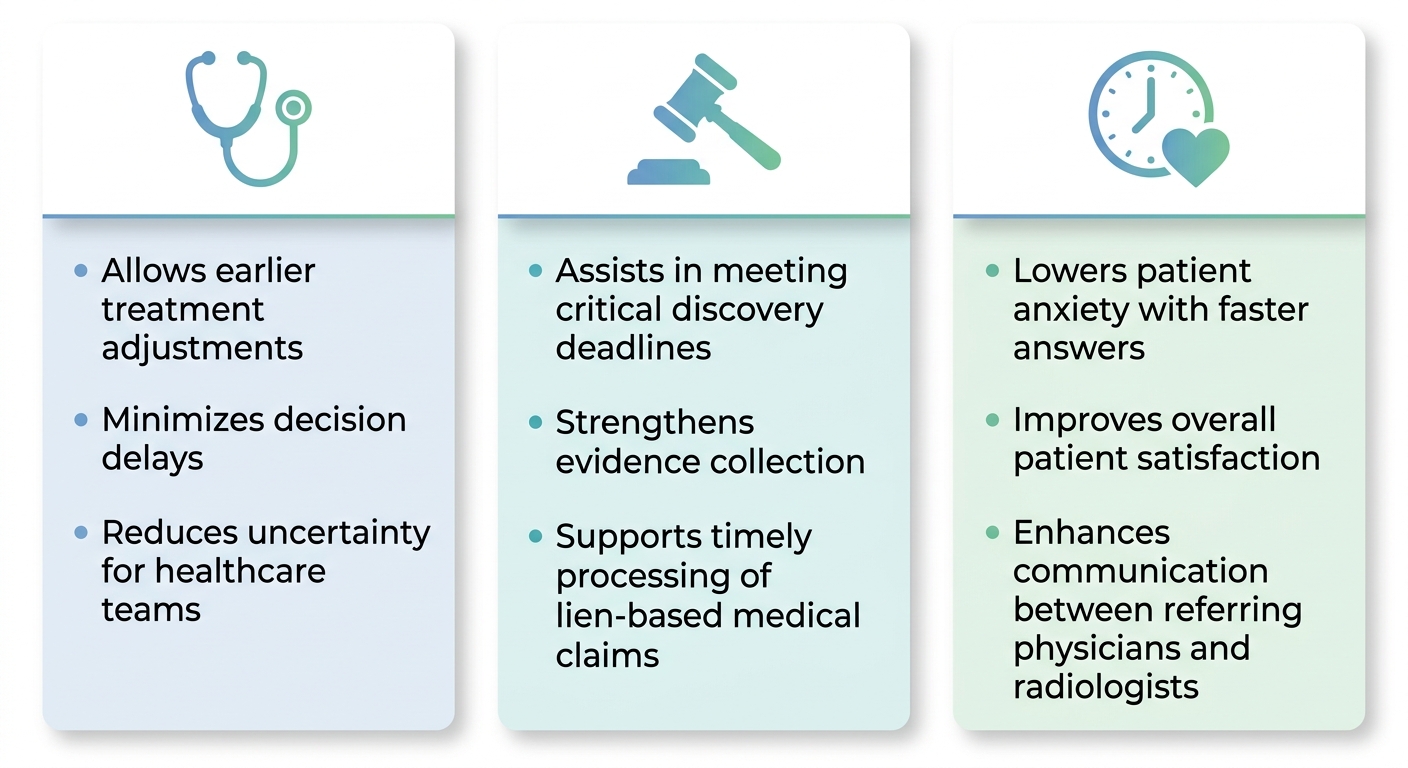
Infographic illustrating the impact of rapid report turnaround on clinical decisions, legal coordination, and patient experience.
The strategic advantage extends beyond individual studies. When a legal team receives a finalized report within 48 hours featuring clear impressions, annotated key images, and a signature from a fellowship-trained radiologist, they can confidently enter mediation or prepare a demand package. Our radiologists are skilled at translating dense imaging data into accessible language that judges, mediators, and claims examiners can understand without losing the clinical specificity required for legal sufficiency.
- Court-ready reports include mechanism-aligned impressions tailored to the specific incident.
- Clear, defensible language bridges the gap between clinical radiology and legal argumentation.
- A 48-hour delivery model keeps personal injury and workers’ compensation cases on a steady forward trajectory.
By integrating clinical rigor with legal awareness, we help both treating physicians and attorneys act decisively. The speed of a radiology report ultimately determines how quickly a patient can move from diagnostic uncertainty toward recovery and, when applicable, fair compensation. Results may vary based on individual patient conditions, but our systems are designed to deliver clarity in every image and confidence in every decision.
How to Navigate Report Turnaround for Fast Case Resolution
The pace at which a personal injury or workers’ compensation claim advances often hinges on a single factor: radiology report turnaround time. When treating physicians and legal teams are waiting for diagnostic clarity, every hour counts. Understanding how to move from image acquisition to a signed, case-ready report as quickly as possible isn’t just an administrative goal — it is a cornerstone of effective case strategy. At AZ Advanced Imaging, we have built our entire workflow around reducing that wait, providing your trusted radiology partner with the systems, subspecialty expertise, and support channels that help you close the diagnostic gap and move cases forward with confidence. The following steps outline how ordering providers and attorneys can navigate report turnaround for fast case resolution, whether the need is for a routine MRI or an urgent stat read.
Steps to Request and Receive Reports Quickly
Efficient report delivery begins the moment an imaging order is created. The single most frequent source of delay is incomplete clinical information — missing ICD-10 codes, absent prior treatment notes, or vague clinical questions that require back-and-forth clarification. To secure a smooth and rapid turnaround, we recommend building the following habits into every request:
- Supply complete order details at the time of scheduling, including the specific diagnosis codes, the mechanism of injury, and a clear clinical question the radiologist should address.
- Use stat flags for any case where a same-day preliminary read will directly impact urgent clinical or legal decisions.
- Communicate directly with our team through our dedicated provider line or secure digital portal rather than relying solely on faxed paperwork.
When an order arrives fully documented, our in-house verification team can begin the insurance check and pre-authorization process immediately, eliminating the multi-day lag that often derails turnaround time for radiology reports. For stat requests, we prioritize the study and deliver a preliminary verbal result within hours, followed by a complete written interpretation. This distinction between stat vs routine radiology reports ensures that truly time-sensitive findings — such as an acute fracture or spinal cord impingement — reach the hands of decision-makers without waiting through the standard queue, while routine studies still benefit from our accelerated 24–48 hour reading protocols.
Working with AZ Advanced Imaging for Seamless Turnaround
At AZ Advanced Imaging, our operational standard is built around what we call the 24–48 Hour Report Turnaround — a benchmark we uphold across every location in Arizona and Texas. The key to that consistency lies in how we handle the pre-imaging process. Before a patient ever steps into our scanner, our insurance verification and pre-authorization team has already contacted the carrier, confirmed benefits, and secured any necessary approvals. For personal injury cases, we accept liens and Letters of Protection, removing the financial bottleneck that stalls imaging at many centers. By the time a patient arrives for their same-day or next-day appointment, the administrative path has already been cleared.
Once the scan is complete, our board-certified, fellowship-trained radiologists — particularly our MSK and neuro specialists — begin their structured review. Because we focus heavily on PI-Focused Radiology Expertise, our readers understand exactly what referring physicians and attorneys need: mechanism-aligned findings, quantitative measurements where relevant, and impressions that are defensible in both a clinical treatment plan and a courtroom. Routine MRI and CT reports are typically finalized and dispatched within 24 to 48 hours, while stat studies return same-day results. This speed is supported by digital report sharing through our secure portal, which pushes completed reports directly to the ordering provider and any designated legal counsel simultaneously. Results may vary based on individual patient conditions and case complexity, but our commitment to disciplined, repeatable workflows keeps our standard turnaround reliable across thousands of cases annually.
Coordinating Between Providers and Attorneys for Faster Results
A fast radiology report loses its value if it sits unread in a fax tray or becomes the subject of a multi-day routing delay between a referring physician’s office and a law firm. At AZ Advanced Imaging, we view coordinated report distribution as an essential part of the turnaround equation. When a study is ordered within the context of an injury claim, we document both the treating provider and the designated legal contact at the time of registration. Our digital reporting platform then delivers the final signed report simultaneously to all authorized recipients — no separate release requests, no additional waiting.
The workflow becomes even more valuable in cases that require peer-to-peer reviews or rapid reconsideration after an initial carrier denial. Our fellowship-trained radiologists participate directly in those insurer discussions, armed with the clinical documentation and imaging evidence needed to resolve disputes quickly. This level of provider-to-attorney coordination means that a complete, court-ready radiology report can be in the hands of counsel within 48 hours of the scan — a timeline that directly addresses the practical needs of personal injury litigation.
AZ Advanced Imaging vs. National Benchmarks for Report Turnaround
The table below places our typical turnaround metrics alongside radiology turnaround time benchmarks published by the American College of Radiology (ACR). These comparisons demonstrate the operational advantage that a PI-focused, administratively streamlined imaging practice provides when case timelines are critical.
| Modality | Average Scan Time | Typical Report Turnaround | Common Use Cases |
|---|---|---|---|
| MRI | 30–60 minutes | 24–48 hours | Brain, spine, joints, soft tissue |
| CT | 10–30 minutes | 12–24 hours | Trauma, abdomen, chest, head |
| Ultrasound | 20–40 minutes | 12–24 hours | Abdominal, pelvic, vascular, musculoskeletal |
These numbers reflect the infrastructure investment we have made to prioritize speed without compromising the thoroughness that referring clinicians and attorneys require. According to the American College of Radiology benchmarks, the national average for routine MRI report turnaround stretches to two to four days — a timeline that can stall a case right when momentum matters most. By delivering routine reports in 24 to 48 hours and stat findings within hours, we close that gap.
Results may vary based on individual patient conditions and case complexity. However, for providers and attorneys managing the pressures of litigation calendars, treatment deadlines, and client expectations, the difference between our standard turnaround and broader industry averages can be the difference between a case that stalls and one that resolves. From the first scheduling call through the final signed report, our systems, our radiologists, and our support teams are aligned around a single objective — delivering clarity in every image and confidence in every decision, exactly when you need it.
Advanced Reporting Protocols: Stat vs. Routine and Benchmarks
Radiology report turnaround time differs significantly between stat and routine protocols, each designed to meet specific clinical needs. We distinguish these advanced reporting pathways based on the urgency of the clinical question, ensuring that critical findings reach referring providers without delay while maintaining efficiency across our standard workflow.
Stat Reporting
A stat report is an urgent protocol activated by acute clinical presentations such as trauma, suspected stroke, or sudden neurological deterioration. When a stat study arrives, it interrupts the radiologist’s routine reading queue for dedicated, immediate review. This pathway prioritizes speed without compromising diagnostic accuracy. Per the American College of Radiology’s Practice Parameter for Communication of Diagnostic Imaging Findings, stat reports begin with a preliminary impression transmitted directly to the ordering clinician, followed by a complete finalized report.
Routine Reporting
A routine report follows the standard imaging pathway for scheduled follow-ups, non-emergent findings, and ongoing treatment monitoring. Studies are processed in the order they are received, allowing our fellowship-trained radiologists to complete a thorough analysis, document complete findings, and issue a final impression. This workflow supports consistent quality across all non-urgent cases while maintaining predictable turnaround expectations for referring providers and patients.
Benchmarks
Our reporting protocols align with established radiology turnaround time benchmarks derived from the ACR Practice Parameter and institutional quality metrics. The following table summarizes the key distinctions between these two protocols and their impact on clinical workflow.
| Metric | AZ Advanced Imaging | National Average (ACR) |
|---|---|---|
| Routine MRI Report Turnaround | 24–48 hours | 2–4 days |
| Stat Report Availability | Same-day (within hours) | Varies; many centers 24 hours |
| Legal Case-Ready Reports | 48-hour documented impressions | Often 5–7 days without dedicated PI focus |
Understanding the distinction between stat and routine radiology reports helps referring physicians and attorneys plan treatment strategies and case timelines effectively. For urgent studies, our radiologists typically deliver a preliminary impression within hours, often fewer than four, while routine reports are completed within 24 to 48 hours, consistent with our internal standards and ACR guidance. Turnaround may vary based on case complexity, prior study availability, and clinical history requirements.
Common Questions About Radiology Report Turnaround
Patients and legal partners often ask how quickly they can expect imaging results. At AZ & TX Advanced Imaging, our standard radiology report turnaround time is 24 to 48 hours for most studies, delivered by board-certified, fellowship-trained radiologists.
This timeline reflects our commitment to the “24 – 48 Hour Report Turnaround” while maintaining rigorous quality standards. The distinction between stat vs routine radiology reports is important: a stat request prioritizes urgent findings for immediate clinical decisions, while routine reports follow our standard workflow. Providing complete clinical information and pre-authorization upfront helps us meet typical radiology turnaround time benchmarks efficiently.
Complex studies, such as traumatic brain injury protocols, may require additional interpretation time to ensure a comprehensive, case-ready review. We advise patients and attorneys in Phoenix, Chandler, and across our service areas to communicate directly with our team for specific expectations. Results may vary based on individual patient conditions.
Your Radiology Partner for Fast, Reliable Diagnoses
When you need accurate imaging results without delay, our radiology report turnaround time sets the industry pace. We deliver comprehensive, board-certified radiologist reports typically within 24 to 48 hours, helping you move from scan to decision with confidence. This commitment to speed aligns with top radiology turnaround time benchmarks, and we tailor our workflows to handle both stat vs routine radiology reports according to clinical urgency.
As your trusted partner, we offer:
- Same-day and next-day appointments during posted weekday hours
- PI-focused radiology expertise with court-ready reports
- Insurance verification, pre-authorization support, and concierge service
- Multi-state presence in Arizona and Texas
Questions about imaging or scheduling? Call 844-641-2111 or find a location to contact your preferred imaging center.