

MRI Reports and Medical Evidence for Injury Claims
Table of Contents
MRI Reports and Medical Evidence for Injury Claims: What You Need to Know
When proving the extent of injuries, MRI reports and medical evidence for injury claims are essential. MRI is a safe, radiation-free modality (RadiologyInfo.org), and our personal injury medical imaging captures objective findings — such as disc herniations, ligament tears, and nerve impingement — that substantiate your case.
- Disc herniations and nerve impingement
- Ligament tears and bone contusions
- Soft-tissue injuries clearly documented for claims
Injury documentation MRI requires more than images. Patients and attorneys often search for mri for injury claim or mri for accident claim when gathering medical evidence. Our PI-focused reports include radiologist interpretations with language aligned to legal needs. When you need an MRI for an injury claim, our 24-48 hour turnaround provides timely medical evidence MRI. MRI reports and medical evidence for injury claims rest on precision; our fellowship-trained radiologists ensure every finding is defensible.
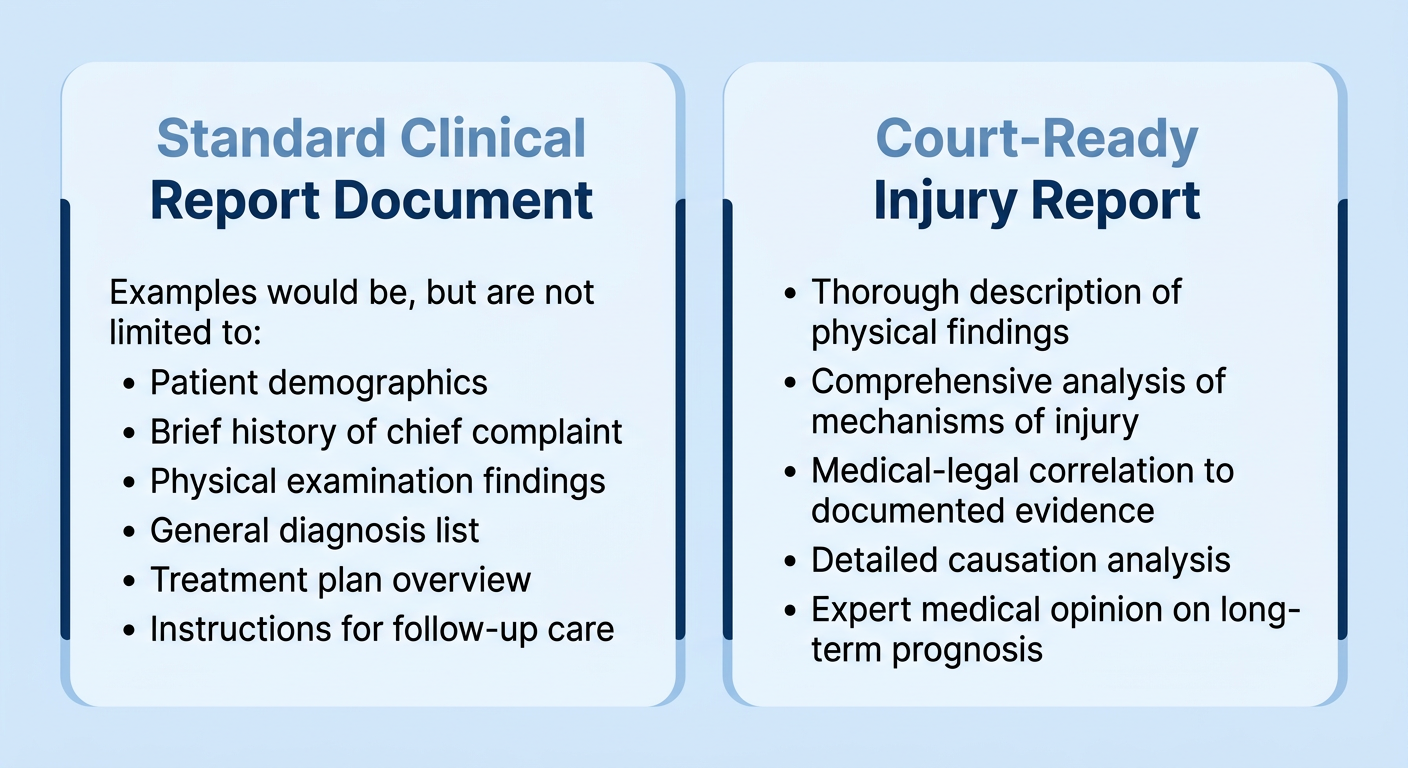
Comparison of standard vs court-ready MRI reports for injury claims.
From scheduling to report delivery, personal injury imaging services with Arizona Advanced Imaging are designed for efficiency. An MRI for an accident claim can be pivotal, and our quick turnaround ensures you have the evidence you need. Clarity in every image, confidence in every decision.
Cost and Process of Obtaining MRI for Injury Claims
Now that we understand the value of MRI evidence in substantiating injuries, let’s explore the practical steps for obtaining it and what coverage options exist. At Arizona Advanced Imaging, we are committed to making this process clear and accessible. Below is a step-by-step overview of the typical workflow for an MRI related to an injury claim.
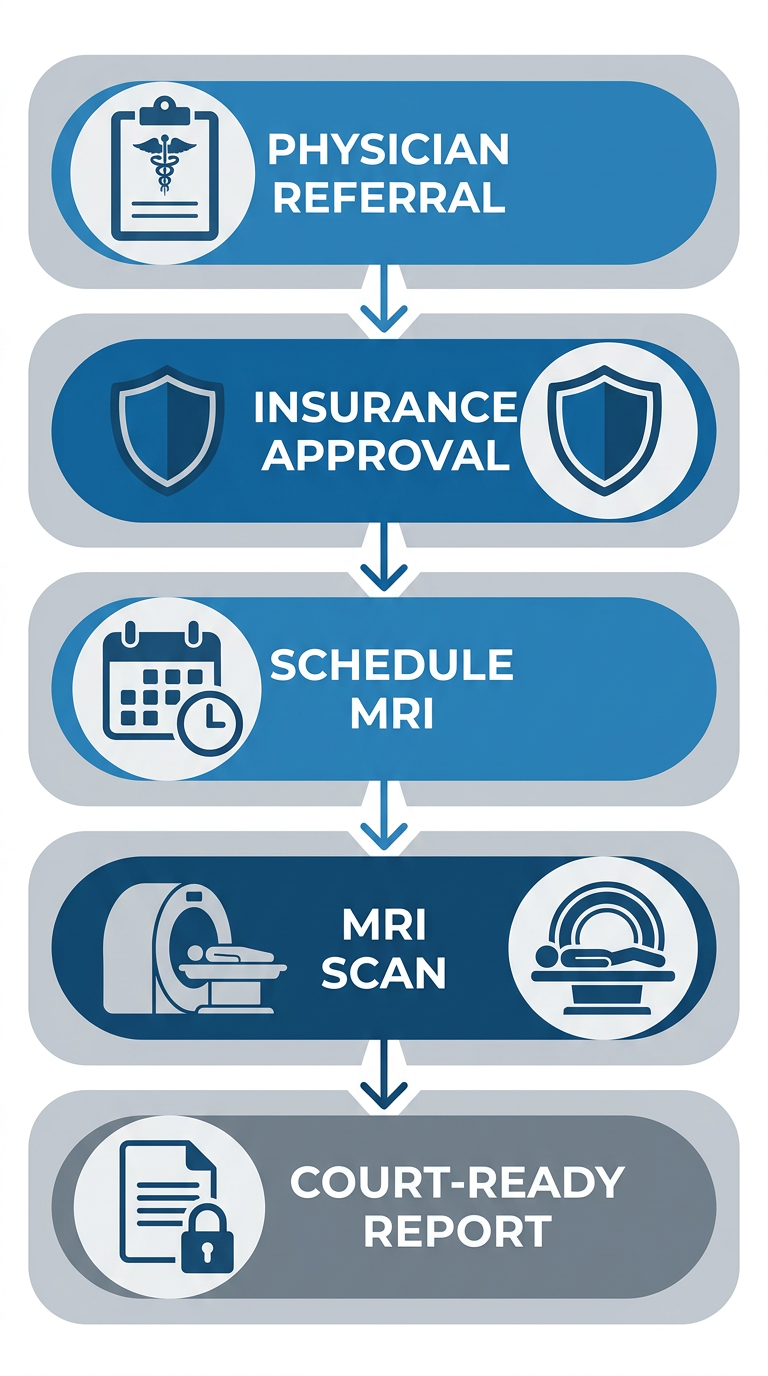
Step-by-step MRI process for injury claims
Understanding each phase helps claimants and their attorneys navigate the path from referral to secure report delivery without unnecessary delays.
How do MRI reports strengthen settlement negotiations and impact settlement value, and why do insurance adjusters require MRI results?
Insurance adjusters depend on objective, third-party evidence to validate claims, and MRI reports serve precisely that function. In a personal injury case imaging can be the deciding factor between a lowball offer and a fair resolution. These reports, interpreted by board-certified radiologists, provide unambiguous documentation of soft-tissue damage, disc herniations, or ligament tears that physical exams alone cannot reveal. When adjusters review mri reports and medical evidence for injury claims, they are less likely to dispute the presence of an injury. This clinical validation directly impacts settlement value by linking the documented harm to the accident, giving your attorney the leverage needed to negotiate from a position of documented strength.
Will insurance or a letter of protection cover an MRI for an accident claim?
Yes, there are several avenues to cover the cost of an mri for accident claim without upfront payment. Health insurance and personal injury protection (PIP) often cover imaging when medically necessary. For those without immediate coverage, a Letter of Protection (LOP) is commonly used in personal injury cases. This agreement, signed by your attorney, guarantees payment to the imaging center from the future settlement or judgment. At Arizona Advanced Imaging, we routinely work with LOPs and medical liens, ensuring that the focus remains on your health, not on administrative barriers. Our team verifies coverage and handles prior authorization so that obtaining an mri for injury claim is as seamless as possible.
What role does MRI documentation play in establishing the severity of a personal injury and what happens if it’s missing?
Comprehensive injury documentation mri is paramount in quantifying the severity of a personal injury. MRI findings can reveal the extent of damage–such as the grade of a muscle strain or the precise location of a nerve impingement–that subjective pain reports cannot convey. This medical evidence mri transforms a claim from a verbal narrative into a medically substantiated case. If MRI documentation is missing or incomplete, the ability to prove causation or the full extent of damages is severely compromised. An adjuster may question the true impact of the accident, potentially reducing the settlement or denying the claim outright. For this reason, we prioritize thorough, timeline-relevant imaging that leaves no diagnostic gap.
Do I need a referral from a physician to get an MRI for my injury claim, and how does MRI evidence help link a specific injury to a past accident?
A physician referral is typically required for an mri for accident claim, as it ensures the study is medically justified. At Arizona Advanced Imaging, we assist with this step by coordinating directly with your treating doctor or attorney to secure the necessary order. Once performed, MRI evidence becomes a powerful tool for linking an injury to a past accident. The temporal proximity between the incident and the imaging findings–such as a fresh fracture or acute soft-tissue edema–establishes a causal connection. Radiologists’ reports often include language that correlates the observed pathology with the described mechanism of injury, providing your legal team with a defensible, court-ready document that solidifies the accident-injury relationship.
What should I look for in an imaging center and what should be included in an MRI package for an accident case?
Choosing an imaging center that specializes in personal injury cases is critical. Key criteria include:
- Board-certified, fellowship-trained radiologists with expertise in musculoskeletal and neurological imaging
- 24-48 Hour Report Turnaround to accelerate legal timelines
- Court-ready reports that are structured for litigation
- Acceptance of liens and letters of protection (no upfront cost)
- Secure digital sharing of images and reports via encrypted portals
Our Personal Injury Care package includes all these elements. For more details, please review our imaging center contact information to speak with a coordinator. We believe that clarity in every image leads to confidence in every decision, which is why we deliver radiology reports that are as meticulous as they are timely.
How can medical imaging records be securely shared with legal professionals and how do diagnostic results help attorneys establish medical damages?
We use encrypted, HIPAA-compliant digital portals to share MRI images and reports directly with your attorney. This eliminates delays associated with physical media and ensures that sensitive information is protected. Once in hand, your attorney can use the detailed radiological findings to quantify medical damages. A report that specifies a herniated disc at C5-C6 with nerve root impingement, for example, translates to clear economic and non-economic damages–such as future medical costs and pain and suffering. By providing objective, high-quality medical evidence mri, we help legal professionals present a compelling, fact-based argument in court or at the negotiation table. Your health and clarity are our priority, and we stand as your trusted radiology partner throughout the claims process.
Legal Evidence, Timing, and Choosing the Right Imaging Services
Beyond diagnostic accuracy, the reports we produce carry significant weight in legal proceedings, serving as a cornerstone for mri reports and medical evidence for injury claims. Our comprehensive personal injury radiology services are designed to provide the clear, defensible documentation that attorneys and patients need, creating confidence in every decision. Choosing the right imaging partner is a critical step in building a strong case from the very beginning.
What specific details should a radiologist include in an MRI report to make it court-ready, and what’s the difference between standard and courtroom-optimized reports?
A court-ready report transforms clinical findings into clear, legally relevant documentation. While a standard clinical report might use terse medical shorthand, our radiologists produce case-ready documents that include a detailed description of findings, explicit clinical correlation explaining how the imaging relates to the reported mechanism of injury, and language accessible to a non-medical audience. This approach ensures the report directly addresses the injury claim’s context. A strong mri reports and medical evidence for injury claims strategy hinges on this detailed, objective narrative that connects diagnostic observations to the patient’s specific accident, strengthening the evidence chain for legal review.
Can an MRI help prove hidden injuries, permanence of injury, and identify injuries not visible on X-rays?
Yes, MRI excels at revealing what X-rays cannot. Injury documentation mri is vital for visualizing soft tissue structures like ligaments, spinal discs, and muscles, exposing tears, herniations, and contusions that standard X-rays miss entirely. This is why relying on a personal injury x-ray imaging approach alone is often insufficient for soft tissue claims. Furthermore, MRI can demonstrate the permanence of an injury by showing chronic changes such as muscle atrophy, fatty infiltration, or scarring, which indicate a long-standing or permanent impairment rather than a recent, temporary strain, solidifying the claim’s legitimacy.
When is the best time to schedule an MRI after an accident to document injuries, and how quickly should an MRI be performed?
Timing is critical; we advise that an mri for accident claim is most effective when scheduled early. The optimal window to capture acute findings is typically within 72 hours to two weeks post-accident. Obtaining an mri for injury claim during this period vividly documents inflammation, edema, and acute hemorrhaging before the body begins to heal or the patterns degrade over time. Immediate scheduling preserves this crucial physiological evidence, directly linking the injury to the traumatic event and preventing defense arguments that the damage could have occurred later or that the findings are merely age-related changes.
How does a fast report turnaround time benefit the progression of an injury claim?
Our commitment to a 24 – 48 Hour Report Turnaround directly accelerates the legal process. Rapid reporting prevents bottlenecks, enabling your attorney to evaluate the case’s full value, initiate settlement negotiations, and connect you with appropriate specialists without weeks of waiting. This speed provides a distinct tactical advantage, demonstrating the objective severity of injuries with immediate, verifiable medical evidence mri details. Quickly receiving a detailed report keeps the claim moving forward, reduces anxiety for all parties, and ensures that critical treatment decisions are informed by timely diagnostics, making us Your Trusted Radiology Partner in personal injury care.
Can specific imaging protocols, like TBI protocols, provide better evidence for accident claims, and are MRI scans the primary objective evidence in TBI cases?
Specialized protocols are often the most critical form of evidence in brain injury claims. Standard brain scans can appear normal, but our advanced TBI protocols, which include sequences like SWI and DTI, can detect subtle yet devastating conditions like diffuse axonal injury and microhemorrhages invisible on typical CT scans. For an mri for accident claim involving head trauma, this provides the primary objective proof of injury. These findings replace subjective symptom reporting with quantifiable medical data, making MRI the gold standard for demonstrating traumatic brain injury in court and ensuring Clarity in every image, confidence in every decision.
How does a fellowship-trained radiologist’s interpretation affect the medical evidence, and why is MRI considered more reliable than other forms of evidence?
A fellowship-trained radiologist’s interpretation is the linchpin of credible medical evidence mri, as their subspecialty expertise in neuro or musculoskeletal imaging leads to more precise diagnoses and respected reports that withstand rigorous cross-examination. Their authority adds irrefutable weight, as they can confidently distinguish acute traumatic findings from chronic degenerative changes. MRI is rightfully considered more reliable for soft tissue and neurological claims due to its superior contrast resolution. For attorneys, having a study interpreted by these specialists transforms a routine image into powerful courtroom evidence. Results may vary based on individual patient conditions, but the expertise behind the read significantly elevates the document’s legal standing.
Get Answers to Your MRI and Injury Claim Questions
MRI reports create objective medical evidence for injury claims. At Arizona Advanced Imaging, our detailed reports serve as reliable injury documentation MRI, giving you strong medical evidence MRI. Our radiologists specialize in personal injury imaging, ensuring your reports meet the standards attorneys need.
Whether you need an MRI for injury claim or an MRI for accident claim, our same-day appointments and 24-48 hour turnaround help you meet deadlines. Your MRI reports and medical evidence for injury claims are accepted as credible proof. We accept personal injury liens, so there are no upfront costs. In addition to MRI, our personal injury x-ray imaging offers further documentation. We coordinate directly with your attorney to streamline the process. Your health and clarity are our priority — contact us to schedule a same-day appointment and get the imaging you need to move your case forward.
Resources
Tempe
AZ
85281